Updated November 2026
Running a small business has never been easy, and 2026 has added new pressure. Engagement is stuck near decade lows, employees are watching for their next job, and federal rules on overtime, worker classification and payroll reporting have all shifted in the past year.
Historically, small business HR has been a patchwork — DIY spreadsheets, separate vendors for payroll, benefits and compliance, and well-intentioned but inconsistent practices. That approach is getting harder to sustain. This guide covers the biggest HR challenges holding small businesses back in 2026 and practical ways to overcome each one.
Key takeaways
- Only 31% of U.S. employees were engaged at work in 2025, according to Gallup — unchanged from 2024 and well below the 2020 peak of 36%.
- 51% of U.S. employees are watching for or actively seeking a new job, and 42% of people who quit say their employer could have prevented it.
- 2026 brought several compliance changes: a restored $684-a-week overtime exemption threshold, a proposed new independent contractor rule, new W-2 codes for overtime and tips, and a $2,000 Form 1099 threshold.
- Consolidating HR, payroll, benefits and compliance with one partner is one of the fastest ways for a small business to cut admin time and risk.
1. The engagement crisis
Employee engagement isn’t a feel-good metric — it drives results. Yet Gallup found that only 31% of U.S. employees were engaged at work in 2025, the same as 2024 and down from 36% in 2020.
The cost shows up on the bottom line. In Gallup’s 2024 meta-analysis of more than 100,000 teams, business units in the top quartile for engagement had 23% higher profitability, 18% higher productivity (sales) and 78% lower absenteeism than those in the bottom quartile.
Why engagement is slipping:
- Employees feel undervalued or disconnected from leadership.
- Limited growth opportunities and career development.
- Poor communication and an unclear company direction.
How to fix it:
- Invest in leadership and workplace culture — managers drive most of the difference in engagement.
- Provide professional development and training opportunities.
- Hold regular one-on-one check-ins to understand employee needs and concerns.
2. The hidden cost of fragmented HR
HR is often treated as a box to check — payroll, hiring, compliance. But juggling separate vendors for payroll, benefits, workers’ comp and HR advice creates duplicated data entry, more room for error and no single view of your workforce. Every handoff between providers is a place where a pay change, a benefits election or a new hire form can fall through the cracks.
How to fix it:
- Map every HR task and who owns it today — you will usually find gaps and overlaps.
- Consolidate HR and payroll services with one provider so information flows from hire to paycheck without re-keying.
- Automate repetitive tasks such as time tracking, PTO requests and onboarding paperwork.
3. Compliance: the rules keep moving
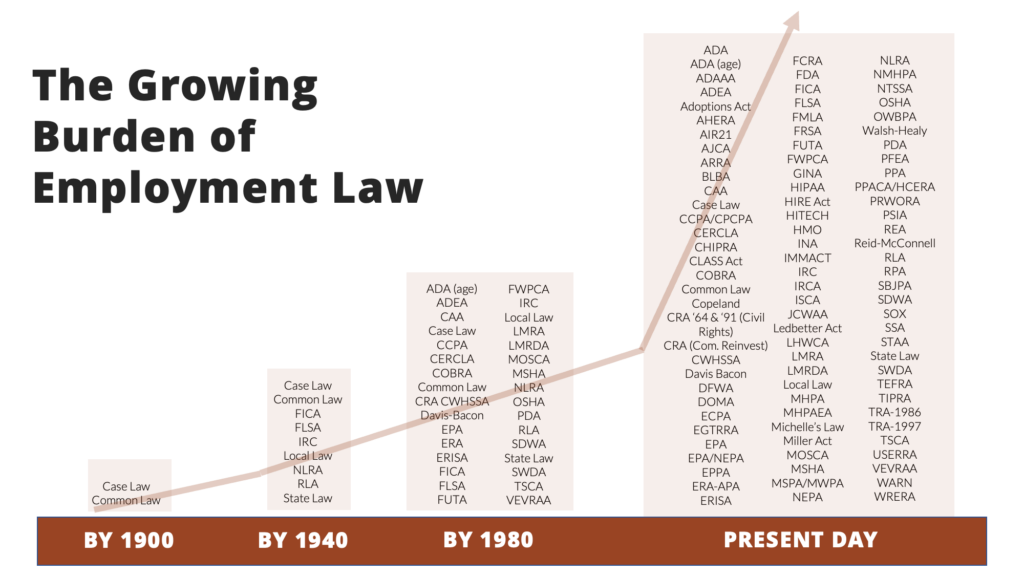
Employment rules changed significantly over the past 12 months. Some of the biggest updates for small businesses in 2026:
- Overtime exemptions: The Department of Labor formally rescinded the 2024 overtime rule in May 2026, so the salary level for the white-collar exemptions remains $684 a week. See our FLSA compliance guide.
- Worker classification: In February 2026 the DOL proposed a new independent contractor rule that would replace the 2024 rule. Read our 1099 vs. W-2 guide.
- Payroll reporting: The 2026 Form W-2 adds codes for qualified overtime and tips, and the Form 1099-NEC/MISC threshold rose to $2,000 for payments made after December 31, 2025.
- Health coverage: ACA penalties and affordability thresholds rise again in 2027. See our ACA compliance guide.
How to fix it:
- Complete our free HR Health Check (5 minutes) to identify compliance gaps.
- Use HR software that keeps accurate records and flags upcoming deadlines.
- Partner with HR professionals who track federal, state and local changes for you.
4. The time crunch
Perhaps the biggest struggle of all is time. Between running operations, managing employees and handling HR, owners end up spending hours on administration instead of growth.
What’s taking up your time?
- Payroll and benefits administration
- Hiring, onboarding and training
- Employee issues and compliance questions
How to fix it:
- Automate repetitive HR tasks.
- Delegate HR administration to a trusted partner — see how HR outsourcing for small businesses works.
- Spend the time you get back on what you do best: growing the business.
5. Turnover and the skills gap
Gallup reports that 51% of U.S. employees are watching for or actively seeking a new job, and 42% of employees who voluntarily left their job say their manager or organization could have prevented it. Replacing an employee costs roughly 40% of salary for frontline roles, 80% for technical professionals and up to 200% for leaders, according to the same research.
Hiring for skills rather than credentials is one response. In ADP research reported by Forbes, 90% of companies that hire based on skills report fewer hiring mistakes, and 94% say skills-based hires outperform those hired on degrees, certifications or years of experience.
How to shift toward skills-based hiring:
- Use practical skills assessments alongside resumes.
- Offer upskilling opportunities to retain and engage current employees.
- Write job descriptions around real business needs rather than rigid credential requirements.
- Build a structured onboarding program so new hires stay.
Frequently asked questions
What are the biggest HR challenges for small businesses in 2026?
The biggest HR challenges for small businesses in 2026 are low employee engagement, high turnover risk, keeping up with changing compliance rules (overtime, worker classification, payroll reporting and ACA), the cost of managing multiple HR vendors, and the time owners spend on HR administration.
How can a small business reduce HR compliance risk?
Start with an HR compliance review, keep accurate records in one HR system, and work with HR professionals who monitor federal, state and local changes. Many small businesses outsource HR administration to a PEO so compliance is handled by a dedicated team.
Is outsourcing HR worth it for a small business?
For many businesses with roughly 10 to 100 employees, yes. Outsourcing consolidates payroll, benefits, workers’ comp and HR compliance with one provider and frees owner time. Learn more about HR outsourcing for small businesses.
Ready to tackle your HR challenges in 2026?
Focus HR helps small businesses cut through HR complexity, reduce costs and reclaim their time — with HR, payroll, benefits and compliance under one roof.
Book a free consultation