Every January brings a fresh wave of predictions. Interest rates. Inflation. The labor market. The economy. By February, many of those forecasts will already look less certain than they did when they were published.
That is not an argument for ignoring the world around you. It is a reminder to be deliberate about where you place your attention.
As you prepare for 2027, the question is not whether external conditions will affect your business. They will. The question is whether you will let them consume the time and energy your leadership team needs to make good decisions, serve customers, and build a stronger company.
Stephen Covey’s principle of proactivity offers a useful filter for the year ahead: focus your effort on the things you can do something about rather than becoming stuck in concerns you cannot change. For business owners, that principle becomes practical when you look closely at how your time is being spent.
You cannot control the economy. You can control what receives your best attention.
The January planning question that matters
As we plan for 2027, many leaders set revenue targets, hiring plans, and strategic goals. Those are important. But there is another question worth asking first:
What work is consuming your leadership capacity—and should it still be?
Think back over the past year. How often did a payroll question, benefits issue, policy gap, employee concern, compliance task, or urgent piece of paperwork derail the work your team had planned to do? None of those responsibilities is unimportant. The problem is not HR itself. The problem is allowing routine, specialist, or administrative HR work to crowd out the work only your leaders can do.
Your calendar tells the truth. If business owners and senior leaders are repeatedly pulled into administration, the business is paying for that work with its most limited resource: focused decision-making time.
A practical way to use Covey’s framework
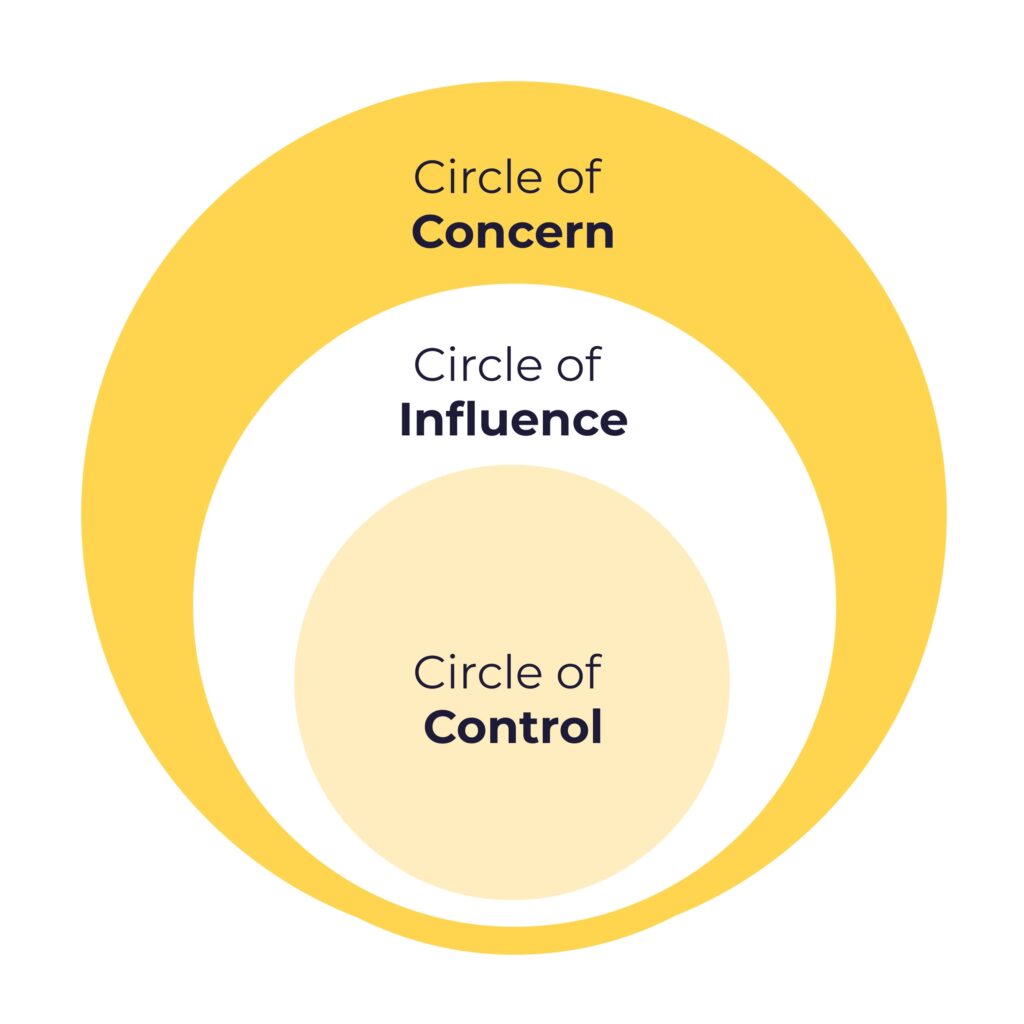
Covey’s original model distinguishes between the Circle of Concern (the broad range of matters that affect us) and the Circle of Influence (the matters where our actions can make a difference).
A useful practical refinement is to separate the innermost actions that you directly control from the broader outcomes you can influence.
| Circle | In a growing business | The leadership response |
| Concern | Economic conditions, regulatory change, competitors’ decisions, or shifts in the labor market | Stay informed, prepare thoughtfully, and avoid spending disproportionate energy on speculation. |
| Influence | Candidate experience, employee development, manager capability, retention, and the quality of your people systems | Build the relationships, processes, and support that make better outcomes more likely. |
| Control | Your priorities, standards, calendar, operating processes, choice of partners, and follow-through | Decide deliberately what to retain, improve, delegate, or stop doing. |
This distinction matters because it changes the conversation about HR. You do not control every employment outcome. You cannot guarantee that a great employee will never leave or that every hire will work out. But you can influence those outcomes by setting clear expectations, equipping managers, improving the employee experience, and giving your people the support they need.
You also directly control whether repeatable administrative work remains a permanent drain on your leaders’ time.
Do what you do best—more consistently
“Do what you do best all the time” is a useful standard for annual planning, provided it is not taken to mean that leaders should disengage from people decisions. They should not.
Business owners and internal leaders should remain close to the work that defines the company: setting direction, creating a healthy culture, holding managers accountable, developing key people, making consequential employment decisions, and understanding what employees need to perform well.
Those responsibilities are strategic. They belong inside the business.
But many HR responsibilities are different. Payroll administration, benefits administration, policy maintenance, routine documentation, compliance tracking, and process design are essential work that often requires focused expertise and consistent execution. They do not always require the owner’s personal attention or a senior HR leader’s entire week.
The goal is not to “get rid of HR.” The goal is to give HR the right operating model, so it becomes an asset to the business rather than a source of constant interruption.
Turn HR support into a 2027 capacity decision
For many small and midsized businesses, outsourced HR is a practical way to protect the work that matters most.
For companies with fewer than 100 employees, an external HR partner can provide foundational HR capability without requiring the business to build every process and specialist function internally. That can mean clearer policies, more consistent administration, stronger documentation, and experienced guidance when issues arise.
For companies with more than 100 employees, the opportunity is often different. There may already be an internal HR team with valuable institutional knowledge and strategic responsibilities. In that case, external support can extend the team’s capacity—helping to keep routine administration, compliance work, and process execution from displacing retention efforts, recruiting, workforce planning, and manager development.
In both cases, the most productive question is not simply, “Should we outsource HR?” It is:
Which HR work should stay closest to our leaders, and which work would be better handled through dedicated systems, expertise, and support?
That question puts the decision squarely in your Circle of Control.
Begin the year with an HR capacity audit
Before Q1 gets busy, set aside time to review how HR work is currently handled. Identify where responsibilities are unclear, processes depend on one person, administrative tasks regularly interrupt leaders, or compliance work is handled reactively instead of systematically.
Then sort the work into three categories.
- First, identify the people decisions and culture-building responsibilities that must remain with your leaders.
- Second, identify the processes that should be standardized and managed more consistently.
- Third, identify the administrative and specialist work where outside support would allow your team to focus on higher-value priorities.
This is not about chasing a generic savings percentage. It is about making an intentional decision about capacity, risk preparedness, and where your most capable people can have the greatest impact.
Make 2027 the year your time reflects your priorities
The economy will do what it does. The labor market will change. New employment challenges will emerge. Those realities belong in your Circle of Concern, and they deserve thoughtful preparation.
But your priorities, systems, standards, and use of leadership time belong much closer to home.
As you plan for the year ahead, do not allow routine HR administration to decide where your best hours go. Keep ownership of the people decisions that matter most. Build the support needed to execute the rest well. Then give your leaders more room to focus on the customers, talent, and strategy that will move the business forward.
Focus HR, powered by OneDigital, helps growing companies build an HR operating model that fits the way they work—whether that means foundational HR support or added capacity for an existing internal team. Prepare for 2027 with a conversation about where your people strategy needs more time, clarity, and support.
Clint Parry, MBA, SHRM-SCP is a Senior Business Consultant at Focus HR, now powered by OneDigital. Based in Arizona, Clint works with growing companies to help them turn HR from an administrative burden into a strategic advantage.