If you’ve been waiting for AI to make HR departments obsolete, the numbers say you’ll be waiting a while, at least for parts of the job.
HR analyst Josh Bersin recently pointed to Lightcast job posting data showing HR-related postings growing at just 1.2% a year over the past two decades, but accelerating to 6% over the last 24 months, precisely the period when AI investment has been heaviest.
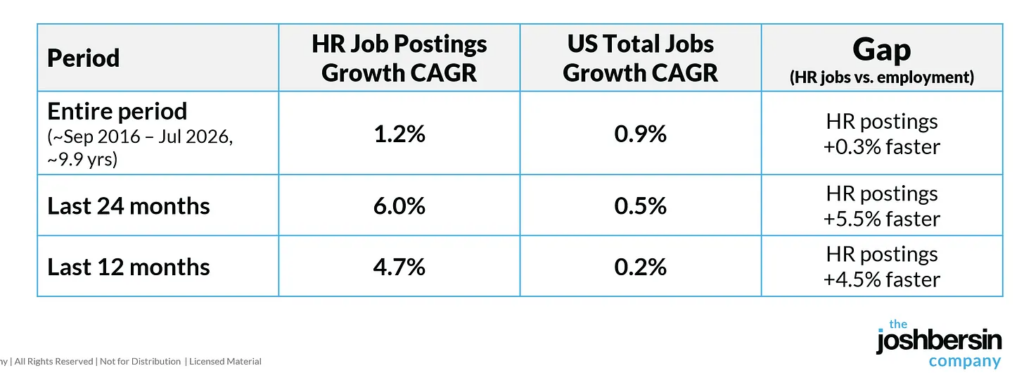
And it’s not just job postings, it’s pay too. Bersin’s Lightcast data shows HR salaries up 82% over 20 years (3.1% a year, compounded) against 66% inflation (2.1% a year) over the same period, meaning HR pay has genuinely outpaced the cost of living, which isn’t true across most professions.
What’s driving that acceleration? Even as AI adoption speeds up, HR is splitting into two different professions, and which side of that split your business lands on will shape how well you manage people, cost and risk over the next few years.
The real split: administrative HR is shrinking, strategic HR isn’t
The numbers above are averages for the whole profession, and averages hide a lot of movement underneath. Wage growth is decelerating fast: Robert Half’s 2026 Salary Guide projects HR salary growth of just 1.6% for 2026, down sharply from 4.0% in 2024. And the part of HR most tied to hiring itself, talent acquisition, had a rough 2025: new BLS data analyzed by recruiting publication ERE shows the Human Resources Specialists category (the closest official proxy for TA roles) shrank by 0.5% in 2025, the first decline since BLS began tracking the category in 2012. HR job postings overall tell a similar story: SHRM found that as of December 2025, they sat at only 78% of their February 2020 level, even as HR headcount kept growing 16% over the same stretch, which points to employers promoting and retaining from within rather than hiring externally for the roles now under pressure.
A detailed labor-market analysis by AIHR explains why. Built with workforce data firm Revelio Labs across 54 HR roles and more than 162,000 active US job postings, it found a consistent pattern: broad, generalist, coordination-heavy roles are losing ground fast, while specialist, analytical and systems-focused roles sit in some of the tightest labor markets in HR.
On the losing side: demand for VP of HR roles fell 71% in six months, and there are now 757 candidates competing for every open VP of HR role. HR Administrator demand fell nearly 30% over the same period, and AIHR flags it as one of the roles most exposed to automation. HR Service Desk Agent demand fell 38%.
On the winning side: demand for Organizational Effectiveness Specialists grew 65%, Learning and Development specialists grew 43%, and the Total Rewards role family (compensation, benefits, payroll) grew 25%, with Payroll Administrator demand alone up 138%, likely reflecting rising pay-transparency and compliance pressure. Some of these specialist roles, such as HR Technologist, have as few as five candidates for every open role, an extraordinarily tight market by comparison.
The pattern holds even for senior titles. A big, broad job title such as VP of HR, HR Director or Senior HR Business Partner no longer guarantees security on its own. What predicts demand is whether the work is specialized, analytical or systems-based, versus the kind of generalist coordination work that AI tools and better HR software can now absorb.
Government projections point the same way for the years ahead. The US Bureau of Labor Statistics forecasts 6% employment growth for HR specialists through 2034, roughly double the 3% projected for all occupations combined. Over the same period, it projects the more administrative HR Assistant role (records, scheduling, day-to-day queries) to shrink by around 7% nationally, an outright decline inside an otherwise growing profession.
This lines up with what’s happening at the more junior end of HR too. SHRM research cited by recruitment analysts at GoodHiresOnly estimates that 85% of recruitment screening tasks and 90% of benefits administration tasks are expected to be automated between 2025 and 2027. That piece focuses mainly on the Indian HR market, but its underlying data reinforces the same split rather than contradicting it: the administrative layer of HR is being absorbed by AI at real scale, while judgment-heavy, relationship-heavy work such as conflict resolution, culture and organizational design isn’t going anywhere.
This isn’t unique to HR
The wider labor market follows suit. PwC’s 2026 Global AI Jobs Barometer, based on close to a billion job ads across six continents, found that jobs requiring specific AI skills grew 69%, almost eight times faster than the 9% growth in the overall jobs market, with a 62% average wage premium attached to those skills. Companies best able to use AI saw headcount grow 52%, against 36% at the least AI-exposed firms, and posted meaningfully higher wage growth too.
Inside HR specifically, adoption is already reshaping daily work. Recruiting data compiled by Pin shows AI adoption in HR functions reaching 43% in 2025, up from 26% the year before, though only 17% of organizations describe their AI implementation as “highly successful”, and two-thirds haven’t proactively trained staff to work alongside the tools they’ve rolled out. Separately, research summarized by Stealth Agents shows 60% of HR leaders used AI for strategic workforce planning in 2025, up from just 29% in 2023, cutting planning cycle times by close to half and helping teams fill critical roles 23% faster while cutting mis-hires by 18%.
The pattern across all of this data points the same way; AI isn’t erasing HR, it’s automating the transactional layer that was always more process than judgment, while, at the same time, raising the bar and the reward for the strategic layer HR was supposed to be doing all along.
What this means for your business
If you run a small or mid-sized business, this has a direct, practical implication.
The HR work paying off right now isn’t data entry, benefits administration, routine screening, or manually chasing compliance deadlines. It’s workforce planning, retention strategy, culture and the judgment calls AI genuinely can’t make.
The problem is that most small businesses can’t split HR into two functions. You likely have one person, or one small team, doing both the administrative load and the strategic work that actually moves the needle on retention and risk. When admin work fills the week, as it usually does, the strategic work is what gets squeezed out. That’s not a reflection on your team. It’s what happens when one role is asked to do two fundamentally different jobs.
This is the gap Focus HR, powered by OneDigital, exists to close, and it’s why we don’t just hand you software and step back. Our cloud-based HRIS platform automates the transactional side directly: multi-state payroll with automatic tax calculations, digital onboarding, a self-service benefits portal where employees manage their own plans and life events, built-in compliance training tracking, and dashboards that surface turnover and labor cost trends without anyone building a spreadsheet. That’s the layer the data above shows is genuinely being automated, so we help seamlessly integrate this automation into your business.
The layer the data shows isn’t being automated, retention strategy, culture, workforce planning – the judgment calls a system can’t make – is exactly what gets squeezed out when your team is buried in admin. Our consultants take that administrative load off your plate and support you on the rest, which frees up your team’s time to focus on the work that actually moves the needle.
The data doesn’t point to less HR. It points to more focused HR. Businesses that make that shift deliberately, rather than waiting for AI to sort it out on its own, will be better placed over the next few years.
Want to see what your HR function could look like with the administrative work automated and the strategic work covered? Book a free consultation with Focus HR to talk through where your team’s time is going, and where it could go instead.
Clint Parry, MBA, SHRM-SCP is a Senior Business Consultant at Focus HR, now powered by OneDigital. Based in Arizona, Clint works with growing companies to help them turn HR from an administrative burden into a strategic advantage.